CarInsurance.com Insights
- Before your teen drives alone: Set three non-negotiable rules: no speeding, no phone use and seat belts on every trip. Add nighttime driving and passenger restrictions, even if your state’s laws are less strict.
- Before you buy a car: Start with used vehicles recommended by the Insurance Institute for Highway Safety (IIHS), an independent nonprofit that tests vehicles for crash safety. Check the exact car’s safety equipment, recall history and insurance cost before buying it.
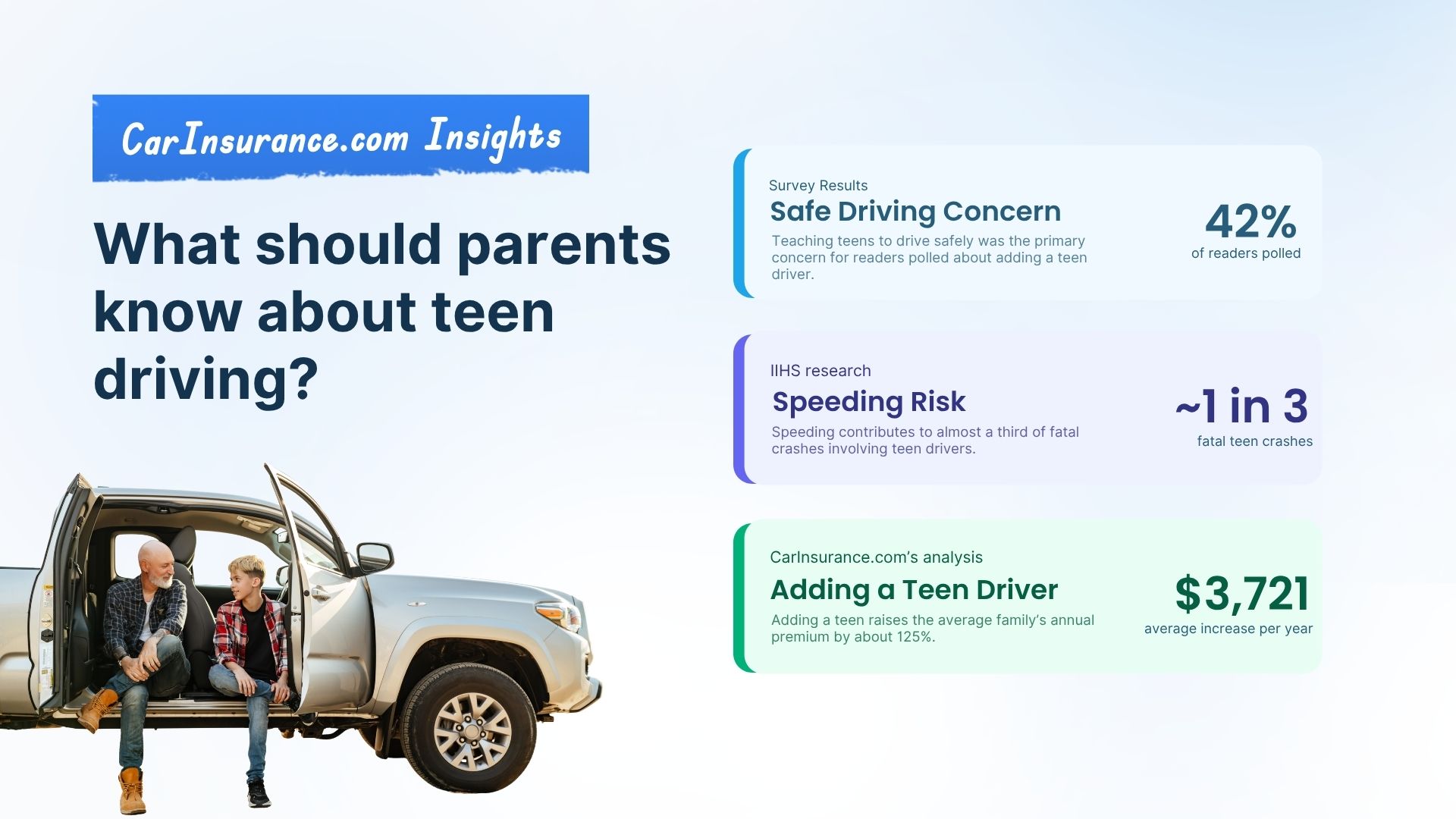
- Before the first insurance bill: Ask about discounts for vehicle safety features, good grades and teen driving programs. Adding a teen increases the average family’s annual premium by $3,721, according to our rate analysis, but costs and available discounts vary.
Your child might be 15 and already asking when they can learn to drive. Maybe there’s a learner’s permit sitting on the kitchen counter, a road test marked on the calendar or a college acceptance letter raising the question of which car they’ll take.
Sooner or later, the keys are going to change hands.
Two worries tend to arrive together: Will my teens be safe behind the wheel? And how much will they cost to insure?
You’re not alone. In a CarInsurance.com poll of more than 1,500 readers:
- 57% said higher insurance cost was their biggest concern about adding a teen driver.
- Another 42% said they are teaching their teens how to drive safely.
As a mom of two teen drivers, Leslie Kasperowicz, editor-in-chief at Insurance.com, knows that preparation includes the things teens might overlook, like safety gear.
“Teens often head out the door without the proper winter gear, so I keep it in the car for them in case it’s needed.”
Teen driving safety isn’t just about what happens behind the wheel. It’s also about the rules you establish, the car you choose, the equipment you keep in it and the insurance decisions you make.
The most useful way to approach it is at three moments: before your teens drive alone, before you buy the car and before the first insurance bill arrives.

What are the most important teen driving safety rules?
The three most important driving safety rules for teens are simple: no speeding, no phone use while driving and seat belts on every trip.
The IIHS reports that speeding contributes to almost a third of fatal crashes involving teen drivers. Put the rules in writing, follow them yourself and add nighttime and passenger restrictions.
Before your teen gets a license, give them experience in different driving conditions.
The IIHS identifies at least 70 hours of supervised driving practice as a best practice for graduated driver licensing (GDL), the system that introduces new drivers to the road in stages.
But those hours shouldn’t consist only of familiar trips around the neighborhood.
Practice should include different roads, traffic conditions, intersections and weather whenever it’s safe to do so. According to the IIHS, the quality and variety of supervised practice matter even more than the number of hours.
Parents can use the IIHS driving skills checklist to identify skills their teens have mastered and those needing more practice.
Driver education can help your teens learn road rules and basic skills, but completing a course isn’t proof that they’re ready to drive independently. According to the IIHS, evaluations of traditional U.S. high school driver education programs have found little or no reduction in crashes per licensed driver.
During the first months of independent driving, limit passengers and nighttime trips.
Crash risk is especially high soon after a teenager receives a license.
Teen passengers increase crash risk, which is why IIHS best practices recommend no teen passengers during the intermediate licensing stage.
Night driving presents another risk. In 2024, 35% of teen driving fatalities occurred between 9 p.m. and 3 a.m., according to the IIHS.
Its recommended nighttime restriction begins at 8 p.m.
Your state’s GDL laws establish legal requirements for teen driving, but you can set stricter rules at home. Check your state’s graduated driver licensing laws before deciding when your teens are allowed to drive independently.
On every trip, make the expectations clear. Tell your teens that:
- Cellphones stay put away while driving.
- Every passenger wears a seat belt.
- Speeding is never acceptable.
Make it equally clear that driving after drinking is prohibited. Every state has zero-tolerance drinking-and-driving laws for drivers younger than 21, and the consequences are severe.
Write down the agreement, explain what happens if a rule is broken and revisit it as your teen gains experience.
Your example matters, too. If you check messages at a stoplight or regularly drive above the speed limit, your teen notices.
A clean driving record also matters financially. Accidents and violations within the previous five years can affect insurance premiums.
What are the safest used cars for teen drivers?
For a teen driver, start with the IIHS list of recommended used vehicles. Its Good Choices meet key safety standards, including a curb weight above 2,750 pounds and a good rating in the driver-side small overlap crash test. Check the exact model, equipment and insurance cost before buying.
Rules help determine how your teen drives. The vehicle you choose helps protect them when something goes wrong despite those rules.
The IIHS and Consumer Reports maintain a list of recommended used vehicles for teenagers.
The recommendations exclude:
- High-horsepower models that could encourage speeding
- Very small vehicles that provide less protection in crashes.
- Extremely large vehicles are also excluded because they can be harder for new drivers to handle.
Several vehicles on the IIHS Good Choices list have starting prices below $7,000, based on recent median retail values for the earliest eligible model year.
Examples include the Nissan Sentra, Kia Soul, Chevrolet Equinox, Mazda3, Hyundai Elantra and Chevrolet Sonic. The list also includes certain model years of the Volvo S60, Nissan Rogue and other vehicles.
These are starting points, not a guarantee that every model year or trim will fit your budget.
More importantly, a vehicle’s safety rating and its insurance premium are two different considerations. An inexpensive used car can still cost a lot to insure for an inexperienced driver.
What should you check before buying a used car for your teens?
- Confirm the exact safety equipment. Some older vehicles earned IIHS safety awards only when equipped with optional crash-prevention technology or specific headlights. Don’t assume every trim has the same features.
- Check the build date. Certain IIHS recommendations apply only to vehicles built after a particular month. For example, the Chevrolet Sonic recommendation starts with vehicles built after February 2015. The manufacturing date is usually on the certification label near the driver’s door.
- Look for outstanding recalls. Use the vehicle identification number (VIN) or license plate to check for unresolved safety recalls. A model may have a good crash-test rating but still require recall repairs.
- Get insurance quotes before buying. Ask at least three insurers to price the exact vehicle with your teen listed as a driver. Compare the same liability limits, deductibles and other coverage options.
- Compare liability-only and full coverage. Liability insurance helps pay for injuries or property damage you cause to others, subject to policy limits. Full coverage generally combines liability with collision and comprehensive coverage, which can pay to repair or replace your own car after covered losses, minus applicable deductibles.
What safety devices for teenage drivers are worth considering?
The most useful safety devices for teenage drivers fall into three groups: features already built into the vehicle, monitoring devices or apps, and insurer-sponsored driving programs. Built-in features help prevent crashes, while monitoring tools can reinforce safer habits. Some equipment and programs qualify for insurance discounts, but savings aren’t guaranteed.
Which built-in safety features should you look for?
Start with electronic stability control (ESC), a system that helps drivers maintain control when the vehicle begins to skid. ESC has been standard on new passenger vehicles since the 2012 model year.
Other valuable features include
- Anti-lock brakes
- Forward collision warning
- Automatic emergency braking
- Lane departure warnings
Some of these features may also reduce insurance costs.
Depending on the insurer, equipment such as anti-lock braking systems, adaptive cruise control, lane departure warning and collision-preparation systems may qualify for discounts of around 3% each.
However, insurers apply different rules, and a discount may affect only part of your premium rather than the entire policy. Also, discounts may not be stacked.
Before paying more for a particular trim or adding equipment, ask which vehicle safety features qualify for insurance discounts.
Can monitoring devices and apps make teenage driving safer?
Monitoring devices and smartphone apps can track behaviors such as speeding, sudden braking, distracted driving and seat belt use. Some alert the teen driver immediately; others send reports to parents. The most useful approach combines feedback during the drive with a conversation afterward about how your teens can improve.
The IIHS’s August 2026 teen driving safety overview describes research showing:
- Seat belt use improved when violations were reported to parents. It improved further when teenagers received in-vehicle alerts.
- Speeding declined consistently when teen received warnings, had an opportunity to correct their behavior and knew parents could be notified.
That makes an important distinction: a monitoring app shouldn’t simply tell you what went wrong after a trip. It should help your teen recognize and correct risky behavior.
Before activating one, explain how it works. Ask what information it records, who can see it, how long it’s stored and whether the data affects insurance pricing.
“Insurance companies are trying to measure the riskiness of each driver and assign a premium that is commensurate with that level of risk. If a teen is a super-safe driver … then telematics would show they are less of a risk, and theoretically, rates could be adjusted downward for that teen,” said James Brau, Joel C. Peterson Professor of Finance at Brigham Young University. “On the other hand … if telematics picks up that the driver is riskier than the premium is currently priced for, the rates could be adjusted upward to match the risk level.”
You can also learn more about privacy concerns involving driving and telematics apps.
Can insurer teen driving programs help lower premiums?
Some insurers offer programs combining driver education, recorded trips and feedback. Completing their requirements may qualify your teen for a discount. Two such programs are State Farm’s Steer Clear and American Family’s Teen Safe Driver program. Check current availability, eligibility and discount terms directly with each insurer.
State Farm Steer Clear is designed for qualifying drivers under 25 with a clean driving record. Participants complete five training modules containing videos, driving scenarios and quizzes.
They also record at least 5 hours of driving across at least 10 trips in the app. Parents can help monitor progress, and eligible drivers can apply for the discount after completing the requirements.
American Family’s Teen Safe Driver program monitors distracted driving and other risky behaviors, scores trips, and gives parents access to the results.
The published program description includes a 10% discount after 3,000 miles or a year of participation for drivers age 21 or younger. Families should confirm the program’s current availability and terms with American Family before relying on that discount.
Sophie’s Tip
If your teens’ car already has driver-assistance features, start by learning how to use them. Add a monitoring app or insurer program if you want more coaching and feedback. Technology is most useful when your teens respond to the warning and you follow up consistently.
Speak with a friendly agent and get your quote in minutes!


What safety gear should a teen driver keep in the car?
Keep blankets, spare gloves, hats and socks, first aid supplies, water, food, hand warmers, light-emitting diode (LED) flares and a flashlight with extra batteries in your teens’ trunk. Add a snow brush, jump starter and traction material.
For Kasperowicz, who lives in Minnesota, keeping an emergency kit ready is part of preparing her two teenage sons to drive.
She keeps the same essential supplies in the car her sons use and in her own vehicle.
“There are some things you should keep in the car throughout the year, like jumper cables, but winter presents new and different risks. Being stuck on the side of the road during a Minnesota winter can be very dangerous.”
Her winter emergency kit includes:
- Blankets: Any blanket can help keep someone warm. A blanket can also block wind coming through a broken vehicle window.
- Extra gloves, hats and socks: Spare winter clothing is especially helpful if your teens leave home without it or get wet in the snow.
- A first aid kit: Keep basic medical supplies together in the emergency bag so your teens can find them quickly.
- Water and high-calorie food: Pack water and shelf-stable snacks, such as protein bars, in case your teen must wait for assistance.
- Hand warmers: Products such as Hot Hands can provide extra warmth when worn inside gloves or boots in freezing conditions.
- Battery-powered LED flares: These help make a stopped vehicle more visible to passing drivers and emergency responders.
- A flashlight: A working flashlight is important when winter darkness arrives early. As Kasperowicz advises, “Don’t forget to pack extra batteries.”
Visibility is particularly important if the vehicle breaks down on a poorly lit road.
“A side-of-the-road breakdown can become a serious accident if other cars on the road don’t see you, and in winter weather visibility can be poor, increasing that risk,” Kasperowicz says.
She also keeps a heavy-duty snow brush, a portable battery jump starter, and a bag of cat litter in each vehicle. The litter can provide traction when tires get stuck on slippery ground.
What else helps prepare a teen for winter driving?
An emergency kit is only one part of winter preparation.
Winter tires may be worthwhile in areas with significant snow and ice. Some insurers offer discounts for snow tires, so ask whether yours does.
Roadside assistance is another option. If your family doesn’t already have access through an automobile club, check what it would cost to add roadside assistance to your insurance policy. Review the towing distance, service limits and other conditions before purchasing.
A backup phone charger helps your teen contact you or emergency services during breakdown. Kasperowicz uses a portable jump starter that also charges phones. Make sure the correct charging cables are kept in the vehicle.
Tire chains may also be useful in mountainous areas, subject to local requirements and vehicle compatibility.
For more information, see our guides to winter weather auto accidents and winter driving safety.
Pack the emergency kit before the first snowfall and keep those spare gloves in the car even when your teens insist they won’t need them.
How could safe driving change what you pay?
Adding a teen driver increases the average family’s annual car insurance premium by $3,721, or about 125%, according to CarInsurance.com’s 2026 analysis.
The average increase ranges from $67 in Hawaii to $7,122 in Louisiana. Rates typically fall most sharply at age 19, and good-student discounts average about 12%, although individual results vary.
You’ve established the rules, thought about the vehicle, considered safety technology and prepared for emergencies. Now comes the number you’ve probably been expecting.
Teen drivers cost more to insure largely because they have less experience recognizing and responding to hazards.
Laura Longero, editor-in-chief of CarInsurance.com, explained why: “18-year-olds have a very short track record of successful driving, and they’re four times more likely to be involved in a car accident per mile driven, according to crash data from the Insurance Institute for Highway Safety (IIHS).”
Your location can make an enormous difference.
In Louisiana, adding a teen raises the average family’s annual policy cost from $4,091 to $11,212. Hawaii is an unusual exception. Its average increase is just $67 because state law prohibits insurers from using age or driving experience as rating factors.
The vehicle, insurer, driving history and coverage you select also influence the final bill.
How can parents manage teen car insurance costs?
Keeping a teen on your policy is less expensive than an individual teen policy. Nationally, adding a teen to a parent’s existing policy costs roughly $3,700 less per year than purchasing a separate teen policy. Drivers younger than 18 generally can’t enter their own insurance contracts, although the applicable age of majority and exceptions vary by state.
Ask about discounts before the policy is updated. A good-student discount averages about 12%, and an approved driver’s education or training course commonly earns around 5%, according to CarInsurance.com data. Ask what grades or course certificates you need to provide.
Maintain a clean record. Accidents and traffic violations can affect insurance premiums for five years. Avoiding them protects your teens and can prevent additional insurance costs.
Compare prices again as your teens gain experience. The largest average single-year decline occurs at age 19, when rates fall about 24%. By age 25, average rates are approximately 59% lower than at 18.
Shopping around can make a difference, even before your teens reach those milestones.
Panos D. Prevedouros, emeritus professor of civil and environmental engineering at the University of Hawaii at Manoa, described what happened when his teenage daughter shopped for insurance after her first six months of driving.
“Immediately after completing six months accident-free, she shopped around and got a much better deal – more coverage and lower premium.”
Before your teens begin driving, ask your insurer when they must be added to the policy, whether at the permit or licensing stage, and confirm when coverage takes effect.
You can also use CarInsurance.com’s InsureMyTeen calculator to estimate the added cost before making changes. The tool doesn’t require personal information to generate an estimate.
Safe driving rules and a clean record protect your teens first and your premium second. As experience builds, compare rates rather than assuming your current insurer will remain the best value.
Sophie’s Tip
If the bill feels steep right now, remember that it’s temporary. Mark the calendar for your teens’ 19th birthday and shop rates again then, because that’s when rates usually drop the most.
Resources & Methodology
How were the teen car insurance costs calculated?
The insurance costs are estimated from CarInsurance.com’s 2026 State of Auto Insurance Report, which analyzes millions of quotes using data from Quadrant Information Services. The figures are averages for specified driver and coverage profiles, not personalized offers. Actual premiums vary by location, insurer, vehicle, driving record, coverage and available discounts.
The sample rate profile uses an 18-year-old driver with a clean driving record and a good insurance score, carrying full coverage with bodily injury liability limits of $100,000 per person and $300,000 per accident, property damage liability of $100,000, and $500 deductibles for collision and comprehensive coverage, unless otherwise noted.
Resources
- Insurance Institute for Highway Safety. “Safe vehicles for teens.” Accessed October 2026.
- Insurance Institute for Highway Safety. “Teenagers.” Accessed October 2026.

 Still have a question? Ask our experts
Get advice from an experienced insurance professional. Our experts will help you navigate your insurance questions with clarity and confidence.
Browse all FAQs