Fire crews near Reno, Nevada, have the Hawk Fire at 98% containment after it burned more than 15,000 acres, destroyed 47 homes and pushed evacuation orders across as many as 90,000 people at its peak. Nevada Gov. Joe Lombardo declared a state of emergency for Washoe County.
As a Reno metro resident, I was shocked to watch the mountains north of the city go ablaze. The first, which was human-caused and began before noon on Saturday, quickly burned out of control.
The effect of climate change on the Sierra Nevada, which borders Reno to the west, has resulted in the second-worst snow drought in 50 years – this year’s snowpack was 73% of average, according to the Los Angeles Times.
The Hawk Fire and Bug Fire (which began Aug. 8 and is 97% contained) are the two largest Reno-area wildfires since Nevada Assembly Bill 376 took effect.
I watched the Hawk Fire burn near Reno, Nevada. What it means for you
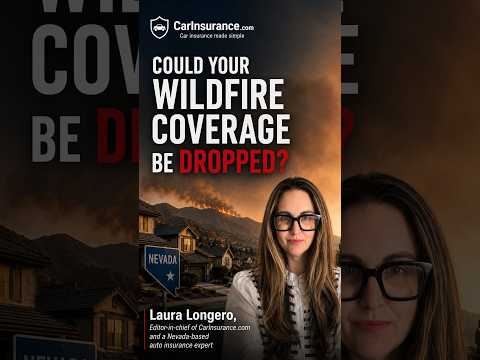
Living in the Reno area, I was shocked to see the mountains north of the city go ablaze. Watching the Hawk Fire happen so close to home showed me how quickly wildfire risk can turn real. I took a closer look at what the fire reveals about wildfire insurance in Nevada, especially after the state’s rules changed in January 2026. In this video, I explain what these changes could mean for Nevada homeowners and what people can do now to better protect their homes and finances. Check out the video for my take on the Hawk Fire, the new insurance rules in Nevada and what homeowners should know.


What insurance rules changed on Jan. 1, 2026?
Nevada is now the first state in the country to explicitly allow property insurers to exclude wildfire from a standard homeowners policy.
AB 376 passed the Nevada Legislature in June 2025, and Gov. Joe Lombardo signed it. Since Jan. 1, 2026, a carrier writing in Nevada has two options it did not previously have. Section 25.1 can carve wildfire out and sell it back as a separate, separately priced policy. Or it can exclude wildfire entirely and offer nothing in its place.
Here’s exactly how the law reads:
- An insurer that issues a policy of property insurance may exclude the peril of wildfire from the coverage provided under the policy.
- An insurer may, subject to any other applicable provisions of this title, issue a policy of property insurance that solely covers the peril of wildfire. Such a policy may be offered: (a) On a standalone basis; or (b) In coordination with a policy that excludes the peril of wildfire pursuant to subsection 1.
The law is structured as a four-year “sandbox” program that enables authorized insurers to test innovative property and casualty insurance products with relaxed regulatory compliance.
The numbers support that reading. Nevada homeowners’ insurance rates climbed 22% from 2023 to the end of 2025, according to the Las Vegas Review-Journal’s reporting on the Nevada Division of Insurance’s latest report.
On the car insurance front, the cost of full coverage car insurance (comprising liability, comprehensive and collision) in Nevada increased similarly: 20% from 2023 to 2025, according to our data.
Nevada has no FAIR Plan
California has one. So do more than 30 other states. A FAIR Plan is the insurer of last resort, the thing that catches homeowners the standard market won’t write.
Nevada doesn’t have one.
So, the state that just became the first to let carriers walk away from wildfires is also a state with nothing underneath to catch the people they walk away from.
Roughly half of all homes in Nevada sit in the wildland-urban interface, or WUI (where developed areas meet wildland vegetation), according to the Nevada Division of Forestry. Between 1990 and 2020, Nevada’s WUI grew faster than any other state’s, up 208%.
We put an enormous number of houses in the path of fire, and we are now eroding the financial protections around them.
What to do this week
If your policy predates Jan. 1, 2026, it almost certainly still covers wildfire. Nothing changed underneath you retroactively.
If your policy was issued or renewed after Jan. 1, pull the declarations page and read it. Look for wildfire named as an excluded peril, or for a separate wildfire policy number sitting alongside your homeowners policy. If you find either, you need to know what the standalone costs are and whether you bought it.
If you can’t tell, call your agent and ask one question directly: Is the peril of wildfire covered under this policy, yes or no? Get the answer in writing. The Division of Insurance issued guidance this week telling residents to do exactly this.
In addition, ask about smoke damage and additional living expenses (ALE) separately, because they often use different language from the fire damage itself. After an evacuation, ALE is the coverage most families use first.
Do this now. Carriers impose moratoriums on new business and coverage changes once a fire is burning nearby, and by then, your options have closed.
Finally, make sure to conduct a thorough home inventory. The National Association of Insurance Commissioners has an app that allows you to capture photos of the items in your home, scan barcodes and group items by room. Why, you ask? Having an inventory in place will make filing a homeowners claim much simpler in case of a total loss.
Speak with a friendly agent and get your quote in minutes!


Make sure you have proper car insurance coverage
In addition to checking your homeowners insurance policy, make sure your auto insurance coverage is active. Comprehensive insurance is the type of coverage that protects consumers against severe weather damage, fire/flood, theft/vandalism, animal strikes – even damage from falling objects or missiles.
Janet Ruiz, director of strategic communication for the Insurance Information Institute, said that 85% of people have comprehensive auto coverage.
“If you have comprehensive coverage on your auto, you will have coverage due to the wildfire if it is damaged or destroyed,” she said.
Comprehensive isn’t as expensive as collision coverage – in Nevada, the annual rate for comprehensive is $297; the national rate is $451.
Steps to take immediately
Coverage is half of it. The other half is making your home the one that doesn’t burn, which increasingly also determines whether you can buy coverage at all. Underwriters are now asking property-level questions they weren’t asking five years ago. Document the work you do.
If you do have to file a claim, Ruiz suggested doing it immediately.
“Contact your insurance company as soon as possible to submit your claim after a wildfire. If you had a mandatory evacuation, keep your receipts for hotel, food, travel costs,” Ruiz said. “Once you return to your property, take photos of damages to your property and belongings.”
The Insurance Information Institute’s guidance breaks down cleanly by distance from the structure.
The first 5 five feet matter most: Keep the 5 feet closest to your house, on every side, free of anything that burns. Gravel, brick or concrete instead of bark mulch, shrubs or a woodpile. This band is where wind-driven embers land and sit, and it is the single highest-value change most homeowners can make in a weekend.
Five to 30 feet: Move RVs, trailers and storage sheds out. Pull shrubs growing under trees, since they are the ladder that carries a ground fire into the canopy. Prune branches hanging over the roof. Clear dead vegetation and replace the most flammable plants. Keep combustible playground equipment, wood or plastic, at least 30 feet out.
The structure itself: A Class A fire-rated roof. Non-combustible siding with six inches of clearance between the siding and the ground. Gutters cleaned on a schedule, with non-combustible covers. Vents screened with metal mesh no larger than 1/8 inch, and boxed-in soffited eaves so embers have nowhere to lodge. Multi-pane tempered glass windows, closed when a fire threatens. Decking that meets the California standard for new construction in fire-prone areas, with the space underneath cleared out.
Fences: This one gets skipped and shouldn’t. A wood fence attached to your house is a fuse running straight to your siding. Use non-combustible material for at least the last several feet where the fence meets the structure.
Final thoughts
Nevada legislators transferred wildfire risk onto homeowners, and they did it quietly, in a way most people won’t discover until they file a claim. There is no requirement that anyone be explicitly told their wildfire coverage has ended.
Make sure to read your declarations page, secure comprehensive auto insurance coverage and create defensible space around your house.
Resources & Methodology
Methodology
CarInsurance.com commissioned Quadrant Information Services to get car insurance rates. The rates are based on sample profiles of 40-year-old male and female drivers with full-coverage policies and limits of 100/300/100 and $500 collision and comprehensive deductibles. Read the detailed methodology for more information.

 Still have a question? Ask our experts
Get advice from an experienced insurance professional. Our experts will help you navigate your insurance questions with clarity and confidence.
Browse all FAQs