CarInsurance.com Insights
- You can insure a new car before you drive it off the lot by adding it to your existing policy or purchasing a new one.
- Most insurers offer a grace period, but relying on it can result in a coverage gap — confirm your policy details in advance.
- Lenders typically require full coverage, including collision and comprehensive, for financed or leased vehicles.
- Comparing quotes before buying helps you avoid overpaying and find the right coverage for your new car.
- Optional add-ons such as gap insurance or new-car replacement coverage can provide additional financial protection.
This guide walks you through the five key steps of buying insurance for a new car, what lenders require and which coverage types are worth adding.

How much car insurance do you need for a new car?
When it comes to a new car, most insurance experts recommend a full coverage policy with liability limits of $100,000 for bodily injury per person, $300,000 for bodily injury per accident and $100,000 for property damage, along with collision and comprehensive coverage.
Your lender requires comprehensive and collision coverage to protect their investment. While these coverages are technically optional under most state laws, they become mandatory under the terms of your loan.
How do you get insurance for a new car?
You can get insurance for a new car in two ways: add the vehicle to an existing policy or shop for new coverage before you finalize the purchase. Either way, you’ll want coverage in place before you drive off the lot.
“Typically, you must have all cars in your household insured with the same company. The new car purchase also has to be a vehicle your insurer will actually insure. In some cases, your insurer may not cover certain specialty vehicles, such as heavy commercial trucks, RVs, motorcycles, and exotic cars,” Bromley says.
“Secondly, when purchasing a new car, you may need to add new types of coverage, adjust your deductibles or raise your coverage amounts. You don’t want to end up underinsured when the unexpected happens. Third, many dealerships and financing companies require that the new vehicle be added to your policy before the transaction is complete.”
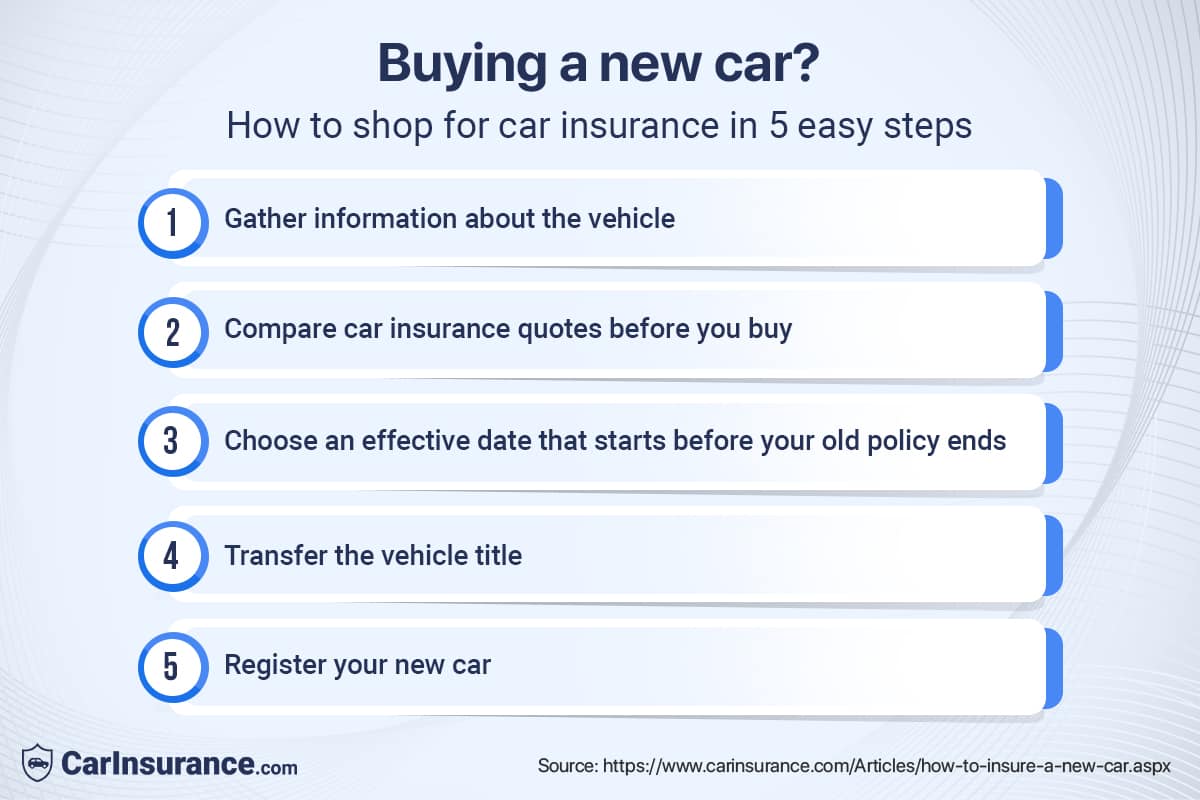
Follow these five steps to get car insurance for a new car.
1. Gather information about the new vehicle
To get an accurate price quote and buy new car insurance, you’ll need some details about the car:
- The vehicle identification number (VIN)
- Make and model
- Year
- Trim package (leather seats, navigation, etc.)
- Mileage
You may not have all this information, but the more details you can provide, the more accurate your quote will be. If you don’t have access to the VIN, you can always provide it after you buy the car.
“You’ll also need to provide the ages and driver’s license numbers for all family members who will be listed on the policy,” Friedlander says.
2. Compare quotes on new car insurance before you buy the vehicle
Get insurance quotes before you buy to understand how much your insurance will cost. You may decide the car you’re interested in is too expensive to insure. It’s better to know this before you buy the vehicle.
“The Insurance Information Institute recommends that you get a minimum of three quotes from a mix of national and regional insurers when shopping for auto insurance to compare costs and coverage,” Friedlander says.
3. Set an effective date on your policy of choice
Once you’ve decided on your coverage and are ready to buy a policy, request that the policy go into effect on the same day you buy the car — but make sure there is an overlap in coverage — even a few minutes should suffice.
If you’d like to wait until after you sign the transaction paperwork, ask the insurer to put the policy on hold until you call them, at which time you can complete the insurance purchase over the phone.
“If you are adding a new car to your existing policy, you can typically do so immediately,” says Bryon Bromley, Michigan-based auto insurance industry expert.
4. Transfer the new car’s title
Curious about how to transfer the new car’s title? The dealership and your lender typically do the title paperwork when you buy a new car. The lender keeps the title until you pay off your loan in full. Once you own the vehicle outright, the lender will mail you the title.
“Each state will have a specific process for transferring the title, including your lienholder when financing a vehicle,” Bromley says. “Your dealership should be able to guide you through the title and registration process.”
When you purchase a new car from a private seller, they will sign the title over to you, and you both will sign the appropriate sections on the back of the title.
Complete the transfer at the Department of Motor Vehicles (DMV). Each state has its own requirements, but typically, the documents and information you need are:
- A bill of sale showing the purchase price
- Proof that the title has been signed over to you
- The VIN (which should be on the bill of sale and title)
- The current odometer reading
You may have to fill out a form to document the title transfer so the DMV can reissue the title in your name.
5. Register the new car
The last step is registering the new car and notifying your insurance company.
“Registering the vehicle is typically handled by the dealership where you purchased it. In a private sale, you’ll need to process the new vehicle registration with your state’s DMV,” Friedlander says.
When you register the car, in addition to the information you need to do a title transfer, you’ll likely need the following:
- Proof of liability car insurance
- Evidence that you’ve paid sales tax on the car purchase
- Certificates showing the car has passed safety and emissions inspections
You now have the information you need to insure your new car with confidence. The right coverage protects a new vehicle from day one, especially if you’re financing. Add it to your existing policy or compare new quotes before you pick up the keys.
When you’re ready to see what coverage costs for your ZIP code, CarInsurance.com’s ZIP code calculator lets you compare options on your own terms — no personal information required until you decide.
Check out our detailed guide on how to get car insurance for first-time buyers
Can you add a new car to your existing policy?
Yes, you can typically add a new car to your existing car insurance policy by calling your insurer or logging into your account online. Contact your insurance carrier to add another vehicle to your insurance or switch vehicles on the policy.
You’ll need the vehicle identification number and details such as the make, model, year and mileage. If you don’t have the VIN yet, it’s all right. You can always add it once you have the keys to the new vehicle.
Adding a second vehicle often qualifies you for a multi-car discount, which can lower your overall premium.
Remember, the more details you can give your insurer, the more accurate the quote on the price difference between the old and new car insurance will be.
Be sure to comparison shop by getting quotes from a few insurers — you may decide to switch car insurance carriers for a better deal.
Speak with a friendly agent and get your quote in minutes!


What type of insurance should you get for a new car?
Full coverage is the standard recommendation for a new car, and for good reason. Lenders typically require full coverage on vehicles with loans.
“Most insurance professionals recommend you obtain full coverage for adequate financial protection from significant losses caused by an at-fault accident,” says Mark Friedlander, director of corporate communications for the Insurance Information Institute. “Purchasing state minimums may leave you and your family financially vulnerable in the event of a loss.”
Collision coverage
Collision coverage pays for damage to your car resulting from a collision with an object — such as a mailbox, guardrail, or telephone pole — or because your vehicle has flipped over. Collision coverage reimburses you for repairing your car, minus the deductible.
“A full-coverage policy typically includes liability limits well above state minimums as well as optional comprehensive and collision coverage, which around 80% of American drivers carry,” Friedlander says. “Some full-coverage policies also include optional uninsured/underinsured coverage.”
Comprehensive coverage
Comprehensive coverage protects your vehicle against damage caused by losses other than collisions, including fire, theft, vandalism, falling trees, floods and other severe weather events. It also covers cracked windshields and animal strikes.
Uninsured motorist coverage
Uninsured motorist coverage is also known as uninsured motorist bodily injury (UMBI) insurance; this coverage will safeguard you and your passengers from medical bills if you are involved in an accident with an uninsured motorist who is at fault. Additionally, this coverage will reimburse you and your passengers for lost wages.
Uninsured motorist property damage (UMPD)
“Uninsured motorist property damage coverage pays for damages to your vehicle caused by an uninsured driver and also covers damage to other personal property,” Friedlander says.
Gap insurance
Bryon Bromley says gap coverage is helpful if you are financing a new car — especially one with a small down payment.
“Your car may depreciate … faster than you pay off the loan, especially at the beginning of the loan period,” Bromley says. “Collision and comprehensive coverage only pay the current value of your car. Without gap coverage, you may be left paying the rest of a loan on a vehicle you no longer own.”
New cars lose about 30% of their value in the first two years and continue to depreciate 8-12% annually after that, according to Kelley Blue Book. Without gap coverage, a driver financing a new car could owe more on the loan than the car is worth after a total loss.
Rental car reimbursement coverage
Rental coverage on a vehicle is optional, and many people don’t think to add it to their policy.
“But if you were involved in an accident tomorrow, would you need a rental car to get to work, for example? If so, you should consider carrying rental coverage,” Bromley says.
Sophie’s Tip
Start with collision, comprehensive and liability at 100/300/100 — that’s your foundation on any new car. Then ask: Would you need a rental car if yours was in the shop? If yes, add rental reimbursement. And if your down payment was small, gap coverage is worth adding before you leave the dealership.
Key takeaways: How to insure a new car
A simple breakdown of what matters most when insuring a new vehicle:
- Start with the right coverage: CarInsurance.com recommends minimum limits of 100/300/100 — $100K bodily injury per person, $300K per accident and $100K property damage — instead of settling for the state minimums.
- Add to an existing policy or shop ahead: If you already have a policy, you can usually add a new car by providing basic details like VIN, make and model. No VIN yet? You can still initiate the process.
- Dealerships often require proof of insurance: Many dealerships or finance companies won’t finalize the sale until you furnish insurance details — so be prepared.
- Always compare quotes: Even if you’re adding a new car to an existing policy, it’s wise to shop multiple insurers. Shopping around and comparing quotes from multiple insurers will help you find better rates and coverage options.
Frequently Asked Questions
What’s the insurance grace period on a new car?
For a short time after buying a new vehicle, that car should be automatically covered by your existing auto insurance carrier, even if you haven’t yet contacted the insurer to add a policy for this car.
“Most auto insurance companies provide automatic coverage for new vehicle purchases equal to the broadest coverage you have on your current vehicle or other cars listed on your auto policy,” Friedlander says. “If you already have an auto insurance policy in effect and purchase a new vehicle, the insurance grace period on a new car will typically run from seven to 30 days, depending upon your insurer.”
Should I get insurance for a new car before I buy it?
Yes, you should get insurance for a new car before you drive it off the lot. Most insurers offer a grace period of 7 to 30 days if you already have an active policy, but if you don’t, you’ll need coverage in place before the purchase is complete.
Does dealer insurance cover me?
A car dealer has automobile insurance on its vehicles so you and others can test-drive them. But it won’t cover you once you purchase the vehicle. You’ll need to buy insurance for a new car.
Source
Kelly Blue Book. “Car Depreciation Calculator.” Accessed May 2026

 Still have a question? Ask our experts
Get advice from an experienced insurance professional. Our experts will help you navigate your insurance questions with clarity and confidence.
Browse all FAQs