CarInsurance.com Insights
- Instant coverage available: Most major insurers activate policies within hours; some offer coverage effective immediately upon payment.
- Comparison shopping saves money: Comparing quotes from 3+ insurers reveals price differences of 20%-40% for identical coverage, based on a CarInsurance.com analysis.
- Online-exclusive discounts exist: Paperless billing, e-signature and online purchase discounts reduce premiums by 2-8% at major carriers.
- Same-day proof of insurance: Digital ID cards download instantly — essential for vehicle registration, DMV visits or immediate driving needs.
Buying car insurance online takes 15 to 30 minutes from start to finish. Compare quotes from multiple insurers, choose coverage limits that protect your assets, apply discounts, and pay to receive a digital insurance card immediately. Most major insurers offer same-day coverage that begins the moment your payment is processed.
I’m Mary Beth Eastman, auto insurance expert and staff writer for CarInsurance.com. As part of my research, I tested the online buying process across eight major insurers: Allstate, American Family, Farmers, GEICO, Nationwide, State Farm, Travelers and USAA. I used identical coverage parameters and tracked factors such as the time it took to complete the process, the information required by the insurer, its coverage transparency and discounts offered. You can view my complete experience in the YouTube video embedded below.
Before you begin, you’ll need your driver’s license number, your car’s vehicle identification number (VIN), the current odometer reading, a driving history for all household drivers and a valid payment method. Having these ready before you start can cut your quote time in half.
This guide blends my real-world testing and expert tips with step-by-step instructions and the data you’ll need to make a decision. We’ll go through the four-step buying process, compare insurers and show you common mistakes to avoid, wrapping up with my expert takeaways. Let’s get started.

How do I buy car insurance online?
Buying car insurance online involves four steps: Comparing quotes from multiple insurers, choosing coverage limits that match your situation, applying discounts to reduce your premium and paying for your policy, which activates it. Most people complete the quote process in about 15 to 30 minutes. Immediately after your payment is complete, you’ll receive a digital insurance card.


Watch CarInsurance.com’s Mary Beth walk through the entire process — including which insurers were fastest and what she discovered about default deductibles and discount transparency.
Step 1: Compare car insurance quotes from different companies
Nearly half of drivers — 48% — don’t realize that identical coverage can cost significantly more with one insurer than another, even in the same ZIP code. That’s because different insurers view your driver profile differently, calculating your price based on location, age, driving record and vehicle, among other factors. Therefore, there’s no universally cheapest insurer, and your price will vary from one company to another.
When you request a quote, you’ll provide information about yourself and the other drivers in the household. When I tested the process, State Farm, Travelers and GEICO auto-populated my household vehicles and drivers accurately, making it fast and easy. On the other hand, my application with Allstate could not be completed online, even after testing out four different ZIP codes to eliminate location as a factor.
Sophie’s Tip
Comparing quotes from three or more insurers typically reveals price differences of 20–40% for identical coverage, making comparison the single highest-value step in the buying process.
Comparing quotes from three or more insurers typically reveals price differences of 20%–40% for identical coverage — making comparison the single highest-value step in the buying process.
Step 2: Select your policy’s coverage limits
Next, you’ll select your coverage limits. The main coverage types are:
- Liability (bodily injury and property damage)
- Collision
- Comprehensive
- Uninsured/Underinsured motorist (UM/UIM)
- Personal Injury Protection (PIP) or Medical payments coverage (MedPay)
You’ll often see coverage limits written in shorthand, like 100/300/100. That means coverage limits of $100,000 in bodily injury coverage per person, $300,000 per accident and $100,000 in property damage.
Choose 100/300/100 liability coverage at a minimum if you can afford it. State minimum coverage levels are rarely enough, leaving you paying many costs out of pocket after an accident.
Your deductible is the amount you’ll pay out of pocket before insurance kicks in to cover collision and comprehensive claims.
The cheapest quote is meaningless if its limits are too low to protect you after a serious accident.
“When I went through each quote, I kept my benchmark at 100/300/100. I noticed some companies defaulted to lower limits — that’s how a $95 quote can look like a bargain until you realize it doesn’t offer the same protection.”
— Mary Beth Eastman, auto insurance expert & staff writer, CarInsurance.com
Step 3: Save money when you buy car insurance online
Increase your deductible
Raising your premium can lower your deductible, but there’s a tradeoff: It increases what you pay out of pocket when you file a claim. Before choosing a deductible, make sure you’re comfortable paying that amount before your insurance kicks in.
With Travelers, my quote was only $56 a month, but it assumed I wanted a $1,000 deductible. I lowered the deductible to $500, and the quote only increased to $64 a month. That’s half the out-of-pocket risk for only $8 more per month.
My advice: Only raise your deductible as high as you can confidently pay after an accident.
“The most surprising thing I discovered was how differently companies display discounts. Some show everything you might qualify for up front. Others only show discounts after they’ve already applied them — without explaining what you’re saving or why.”
— Mary Beth Eastman, auto insurance expert & staff writer, CarInsurance.com
Ask about car insurance discounts
Insurers vary in how they offer discounts, so check with your insurance company to make sure you’re getting all discounts for which you may qualify.
For example, Farmers proactively asked for my kids’ GPAs and auto-applied its good student discount. Travelers showed the exact dollar amounts saved per discount, not just percentages. And GEICO displayed a long list of potential savings, but none applied to me.
Bundling home and auto could save you up to 14% on car insurance.
| Discount type | Typical savings | How it applies |
|---|---|---|
| Bundling (home + auto) | Up to 14% | Provide homeowner/renters policy details at quote |
| Good student | 12% | GPA (typically 3.0+) — Farmers, State Farm, GEICO offer this |
| Paperless billing / e-signature | 2% | Select at checkout — online-exclusive at many carriers |
| Paid-in-full | 8% | Choose annual payment vs. monthly at checkout |
| Anti-theft device | 1% | Disclose security system during quote |
| Telematics / usage-based | 7% | Enroll in program (e.g., Nationwide SmartRide, State Farm Drive Safe & Save) |
Step 4: Pay for your new car insurance policy and get your insurance card
Most insurers accept credit and debit cards and ACH bank transfers. You could get a discount for paying in full up front instead of making monthly payments.
Most major insurers will activate your coverage immediately upon payment. Some set coverage to begin at midnight on the date of payment, so check with your insurer to be sure. Make sure the start date is the same day your old policy ends, not after. Even a one-day gap could be flagged as a lapse in coverage.
You can download your digital insurance cards instantly after payment. That’s handy since most states accept digital proof of insurance on your smartphone. Tip: Screenshot or email the cards to yourself immediately as backup.
Credit score vs. credit-based insurance score: What’s the difference?
Insurers in many states use a credit-based insurance score, not your standard FICO credit score, to assess your likelihood of filing a claim. Even with a frozen credit file like mine, insurers can still access your file for underwriting purposes. This is legal and standard practice.
While researching, I noticed that Travelers had the clearest fine-print disclosure about credit-based scoring out of all the companies I tested. That’s useful as a benchmark for trust.
Which companies offer instant online car insurance?
Most major insurers — including State Farm, Travelers, GEICO, Farmers and Nationwide — offer instant online car insurance, with coverage activating immediately upon payment. “Instant” typically means your digital insurance card downloads within minutes. A handful of large insurers, including Allstate, may require phone contact first, depending on your ZIP code.
You can purchase auto insurance completely online with major insurers, including most I tested: Farmers, GEICO, Nationwide, State Farm and Travelers. However, Allstate stood out as an insurer where I could not complete the process online across any ZIP code I tested, including Ohio, Illinois, California and Pennsylvania.
Note that “same-day” and “instant” activation aren’t quite the same. Some insurers will activate your policy at midnight of the purchase date, not the moment of payment.
Sophie’s Tip
The best online insurer is the one that works for your ZIP code and driver profile — not just the one with the flashiest checkout.
Which car insurance company has the best online shopping experience?
State Farm and Travelers led our testing for overall online experience — fast, highly transparent and easy to customize. Farmers earned the highest marks for discount depth. Nationwide offered the clearest coverage display. Allstate was the only insurer that could not be completed fully online across any of four ZIP codes tested.
Key finding from Mary Beth’s test:
- State Farm: Coverage comparison tool excellent; showed nearby agents; auto-recognized vehicle & drivers
- Travelers: 8 discounts shown with exact dollar amounts; clearest credit score fine print of all 8 tested
- Farmers: Asked for GPA; good student discount applied; most customizable; welcome & anti-theft & homeowner discounts
- Nationwide: Only counts 3+ minor violations; SmartRide 10% applied upfront; clearest coverage display
- GEICO: Auto-populated vehicles and drivers; many discounts listed but none applied to Mary Beth’s profile
- American Family: Auto-pulled all residents & vehicles at address; unavailable in PA — ZIP-code specific
- USAA: Military eligibility screening; offered partner quotes when ineligible — thoughtful UX
- Allstate: Could not complete online in any of 4 ZIP codes; required phone call; first call dropped
| Insurer | Time to quote | Sample quote | Coverage shown | Best for |
|---|---|---|---|---|
| State Farm | 5 min | Not shown | 3 tiers shown | Best overall UX |
| Travelers | Very fast | $56-$64/mo | 100/300/100 | Best transparency |
| Farmers | 9 min | $150-$170/mo | 50/150 base | Most discounts |
| Nationwide | Fast | $89.29/mo | 100/300/100 | Best for minor violations |
| GEICO | Fast | $95/mo | 50/125 | Fastest for simple needs |
| American Family | N/A | Not completed | N/A | Best auto-fill |
| USAA | Varies | Not quoted | N/A | Best for military |
| Allstate | 21+ min | $164/mo | Not stated | Not recommended online |
State Farm: Best overall online experience
State Farm offered a speedy, five-minute process, including a three-tier coverage comparison tool showing basic, standard and the closest to my current coverage. It auto-recognized my household’s vehicles and drivers and showed nearby agents with their contact information. Best for drivers who want speed and transparency in one session.
Travelers: Best for transparency and fine print
My quote with Travelers was $56 a month with a $1,000 deductible and $64 a month with a $500 deductible — a clear example of the deductible trade-off. I was shown eight discounts with exact dollar amounts, not just percentages. Travelers provided the clearest disclosure of credit-based insurance scoring among the eight insurers I tested. Best for detail-oriented shoppers who want to see exactly what they’re saving.
Farmers: Best for discount depth and customization
Farmers offered a nine-minute quote process in which I was proactively asked for my students’ GPAs and offered good student, welcome, anti-theft, homeowner and multi-car discounts. Farmers had the most customizable process of the insurers I tested, providing an initial quote of $150 per month for two cars and four drivers at 50/150/50 coverage. Adding roadside assistance, rental car coverage and a declining deductible brought the quote to $170 per month. Best for families with student drivers or those looking for multiple discount opportunities.
Nationwide: Best for drivers with minor violations
Nationwide offered a clean, simple quote process, with a 10% SmartRide discount offered up front. It only counts minor violations if there are three or more, so the speeding ticket in our household didn’t affect my quote. I received a quote of $89.29 per month for strong 100/300/100 coverage, with a $500 deductible, medical benefits and accident forgiveness. Best for households where a less-than-perfect driving record could be an obstacle elsewhere.
GEICO: Fastest for simple profiles
GEICO’s process was super fast, auto-populating my vehicles and drivers. Despite a long list of military and affinity discounts, I qualified for none of them. My quote of $95 per month came with 50/125/50 limits and a $1,000 comprehensive deductible, offering less value than other insurers. Best for drivers with simple profiles who know their coverage needs and want to move fast.
American Family: Best autofill experience
I loved American Family’s seamless application, which auto-pulled all residents and vehicles at my address, giving me the option of choosing which to insure. However, I was disappointed that coverage wasn’t available in my home state of Pennsylvania. Best for drivers in American Family’s coverage area who want a frictionless start to the quote process.
USAA: Best for military members, veterans and their families
USAA offered a clear eligibility screening process, which is useful given that they only serve eligible military members and their families. When I didn’t qualify for coverage (despite having family who served), USAA offered partner company quotes, so I still had a path forward instead of a dead end. I found that to be a thoughtful way to handle it. Best for those who qualify (veterans, active military and their immediate families), as USAA consistently earns top J.D. Power satisfaction scores.
Allstate: Requires phone contact in many areas
My experience with Allstate was less than ideal. I tried and failed to complete an online quote across all four ZIP codes tested: Pennsylvania, Ohio, Illinois and California. I placed a phone call to Allstate, but the first call dropped; the second took 21 minutes to connect and offered a quote of $164 per month for two cars and two drivers. On the plus side, the agent was helpful and friendly. Best for those willing to call; not suitable for online-only insurance purchases.
“Speed varied wildly. State Farm took five minutes from start to finish. Allstate took over 21 minutes — and that’s not counting the dropped call. If speed is your priority, the difference between insurers is not small.”
— Mary Beth Eastman, Auto Insurance Expert & Contributing Researcher, CarInsurance.com
Pros and cons of buying car insurance online
Pros
- Available 24/7 — no appointment, no hold music, no office hours
- Compare multiple insurers side-by-side in one session
- Instant digital proof of insurance upon payment
- Online-exclusive discounts (paperless, e-sign) are not always available through agents
Cons
- Some major insurers (like Allstate) cannot be fully completed online in all ZIP codes
- Default settings — deductibles, coverage limits — may not match your needs and are easy to miss
- Complex situations (classic cars, high-risk drivers, coverage gaps, SR-22) may benefit from agent guidance
- You must know your coverage needs — no one will ask the right questions on your behalf
Online insurance quotes vs. online insurance purchases: What’s the difference?
An insurance quote is an estimate that can change; a purchase is a binding agreement. Your final price may differ from your quote if the insurer discovers discrepancies during underwriting. These could include unreported accidents, driving history mismatches or VIN details revealing prior claims. You’re most likely to see a gap between quote and final premium when you rush the information-gathering step.
Quoted prices can change for a number of reasons, but entering inaccurate information during the quote stage is one of the most common. Driving record discrepancies, inaccurate household driver details and omitting VIN-level data like prior claims can all affect your final price.
Look carefully at what the quote offers, too. The quote I received from GEICO was $95 per month; it looked like a bargain until I saw that it provided 50/125/50 limits and a $1,000 deductible — much higher than other quotes I received.
For the most accurate quotes, gather accurate information on all household drivers’ histories and determine your desired coverage limits first, before you check prices.
Sophie’s Tip
A quote is a preview. Only the declarations page — the document you receive after purchase — confirms your actual coverage, limits and premium.
Speak with a friendly agent and get your quote in minutes!


What to do if your preferred insurer doesn’t offer online purchasing
Sometimes, regional carriers, specialty insurers (such as for classic cars or high-risk drivers) and larger insurers like Allstate may require contacting an agent to purchase. That doesn’t mean you have to overpay or give up convenience entirely. You can still research online, use comparison tools and prepare your information before handing off to an agent for the final step.
Some insurers operate strictly through agents. What they lack in convenient online purchasing, they make up with competitive rates and high customer satisfaction scores. Regional carriers, specialty insurers and smaller mutual companies often work this way.
Even some of the largest U.S. insurers, like Allstate, can require an agent phone call to buy a policy. I tried purchasing through Allstate’s website, but the process wound up requiring a 21-minute phone call instead.
Start a quote online, then call to bind your policy
Many agents-only insurers allow you to begin the quote process online, gathering and entering information before handing off the transaction to an agent. This can save time on the phone because all of your information is pre-entered. That’s why my second call to Allstate was successful: the agent had context for my call, and the quote portion of the process took 15 of the 21 total minutes.
Use an insurance marketplace or comparison tool to check rates
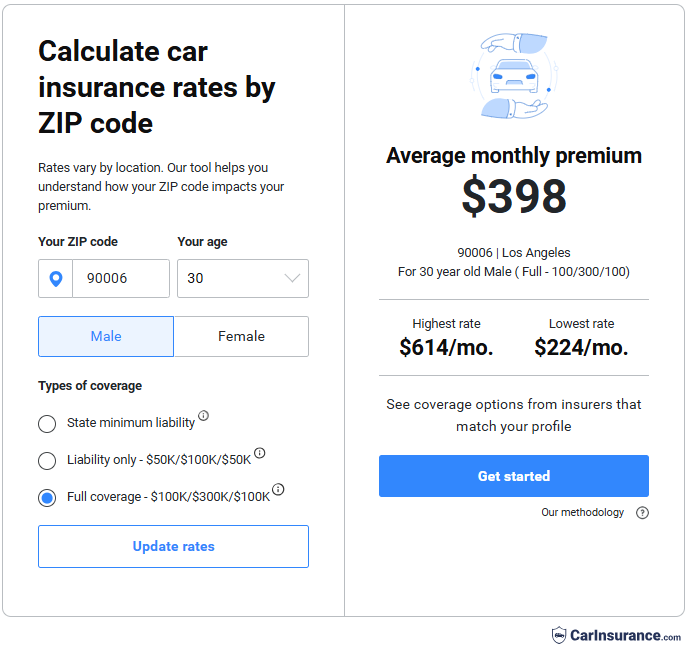
Use CarInsurance.com’s ZIP code rate comparison tool to see side-by-side rates across both online- and agent-based carriers before calling.
Ask if they’ll email you an application
You can also ask if an agent-only insurer will email you a pre-filled application based on your phone conversation. All you need to do is review, electronically sign and return, minimizing back-and-forth.
Switch temporarily, then revisit later
Another option if you need coverage today is to purchase from an online carrier for now, then switch to your preferred, agent-only carrier at renewal, when you have time for the phone process.
Don’t compromise on coverage or price just for online convenience
Online convenience is great, but price and the quality of your coverage matter more. A phone-based insurer with 5% lower premiums and higher coverage limits is still the better deal, even if the process takes 20 minutes.
What mistakes should I avoid when buying car insurance online?
The biggest mistake when buying car insurance online is comparing prices without standardizing your coverage. A $56/month quote and a $95/month quote are meaningless side-by-side if one carries a $1,000 deductible and 50/125 limits while the other has a $500 deductible and 100/300/100 limits. I experienced this exact scenario when comparing Travelers and GEICO.
1. Purchasing only the state minimum liability coverage
State minimum coverage is often far below what’s needed to protect your assets after an at-fault accident, so it’s best to scale up.
Typical minimums are 25/50/25 in many states, compared to the 100/300/100 limits that I used as a benchmark in my research. But if an accident causes $300,000 in medical bills, having only $50,000 in coverage would leave a gap of $250,000 you’d have to pay out of pocket.
2. Providing inaccurate information during the quote
Leaving out key information during the quote stage is the most common reason your final premium will differ from your original quote. That includes things like failing to disclose a household driver, understating your annual mileage or not reporting a prior accident.
Be honest in your application. Providing false information during the process can result in a claim denial later, not just an adjustment to your premium.
3. Skipping comparison shopping
Don’t forget to compare quotes from multiple insurers. Remember, 48% of drivers don’t realize there can be major price differences from one insurer to the next for identical coverage.
No single insurer will be the best for every driver profile, so it’s important to shop around to see which offers will be best for you.
4. Overlooking discount eligibility
Discounts vary greatly by insurer, so you should always ask what’s available.
In my research, Travelers showed the exact dollar amounts I’d be saving, while Farmers applied the good student discount proactively. Many discounts, like good student, defensive driver or telematics, require you to provide documentation, so be prepared to offer it.
Sophie’s Tip
Don’t assume your discounts are automatically applied. Ask each insurer to list every discount your household qualifies for.
5. Not understanding deductibles before you buy
Watch the deductible. A $1,000 deductible can make a quote 10% to 15% cheaper than a $500 deductible, but it doubles your out-of-pocket cost if you need to file a claim.
Higher deductibles can mean lower premiums, but you must be able to afford the deductible you choose. Before you accept any quote, manually change the deductible to what you can realistically afford to pay the day you need to file a claim.
6. Missing a payment deadline after purchase
If you miss a payment, you risk losing coverage — and that lapse can make it harder and more expensive to get coverage again later. Reinstating a lapsed policy often carries fees, and it can trigger a premium increase at renewal.
Set up autopay immediately after purchase to ensure your payments arrive on time. You can find the payment schedule on your declarations page.
7. Letting your old policy lapse before the new one starts
Even a one-day gap in coverage could be enough for insurers to flag it as a lapse, causing your premium to go up the next time you renew.
Drivers with even a brief coverage gap might pay more for their next policy.
8. Not reading your policy documents after purchase
The declarations page (or “dec page”) is the document that confirms your actual coverage, not the quote screen. Review your declarations page within 24 hours of purchase. Some key points to verify include VIN, all driver names, coverage limits, deductibles and policy start and end dates.
Sophie’s Tip
Your declarations page is your insurance receipt. Review it before you drive — not after you need to file a claim.
Key takeaways from our insurance expert
Always match coverage apples to apples
Before comparing prices, make sure you’re comparing the same parameters — liability limits, deductibles and coverage types should be the same across every quote. In my testing, I found that what appeared to be a $ 39-per-month price difference between two insurers was actually a significant difference in deductibles and liability limits. Set your parameters first, then compare prices.
Watch those default deductibles
Default deductibles are often set at $1,000 to make the quote look cheaper. Before you accept any quote as final, change the comprehensive and collision deductibles to what you can realistically afford to pay after an accident. The difference between a $500 deductible and a $1,000 deductible was just $8 more when I was exploring rates with Travelers.
Quote tools vary wildly — plan accordingly
What took five minutes with State Farm took more than 20 minutes and a phone call with Allstate. Farmers took just nine minutes and provided the most detailed discount breakdown of all insurers I tested. If speed is your priority, start with State Farm of Travelers; if you want to maximize every discount, invest the extra time with Farmers.
None of the quoting tools was identical, so budget your time accordingly and don’t expect the process to be uniform.
Sophie’s path: Navigate your online purchase
Phase 1: Before you start
- Gather your driver’s license and all household drivers’ licenses
- Locate your vehicle’s VIN — on the dashboard (visible through the windshield), door frame or vehicle registration
- Estimate your current annual mileage from your odometer
- Pull up your current policy declarations page — note your existing coverage limits and deductibles
- Have a payment method ready: credit card or bank routing and account numbers
Phase 2: While you quote
- Use identical coverage limits and deductibles across every insurer you compare
- Manually change default deductibles to what you can afford — don’t accept the pre-set amount
- Ask about or look for all applicable discounts: good student, bundling, telematics, pay-in-full
- Get quotes from at least three insurers before making a decision
- If a quote tool isn’t clear about coverage details, that’s a signal — ask before purchasing
Phase 3: After you buy
- Download your digital insurance card immediately — screenshot or email to yourself
- Review your declarations page within 24 hours: Verify VIN, driver names, limits and deductibles are correct
- Set autopay or a calendar reminder for your first payment due date
- Set a renewal reminder 30 days before your policy expires
- Cancel your old policy — effective the same date your new policy starts (not before)
- Notify your lender if you have a financed or leased vehicle — lenders require proof of comprehensive and collision coverage
Frequently Asked Questions: Buying car insurance online
Can you purchase car insurance online?
Yes. Most major U.S. auto insurers — including State Farm, Travelers, GEICO, Farmers and Nationwide — allow you to complete the entire process online, from quote to payment to digital insurance card. A few larger insurers, including Allstate, may require phone contact depending on your ZIP code. CarInsurance.com’s testing confirmed the process typically takes 15–30 minutes online for most carriers.
Is it cheaper to buy car insurance online?
Buying online can be slightly cheaper because of online-exclusive discounts — paperless billing, e-signature and direct online purchase discounts typically reduce premiums by 5-10%. The bigger savings come from comparison shopping: Comparing three or more insurers for identical coverage typically reveals significant price variation for the same driver profile. Online access makes that comparison faster and easier.
When and why might you prefer to buy from an agent?
An insurance agent adds the most value when your situation is complex: Multiple drivers with violations or accidents, coverage gaps, specialty vehicles (classic cars, RVs, high-value vehicles), SR-22 filing requirements or if you’re bundling home and auto and need custom underwriting. Some regional and mutual insurers also offer their most competitive rates exclusively through agents. Online is fast — agent-based is sometimes smarter for your specific profile.
What are some common myths about purchasing insurance online?
Myth 1: Online is always cheaper: not true. Agent-based carriers can be more competitive for complex profiles.
Myth 2: You need your Social Security number to get a quote. Most online tools use a soft credit pull and don’t require an SSN at the quote stage.
Myth 3: You can’t get same-day coverage online: False. Most major insurers activate coverage immediately upon payment and provide a digital card within minutes.
Is it safe to buy car insurance online?
Yes, when purchasing directly from a licensed, established insurer. Verify the insurer is licensed in your state through your state’s department of insurance website. Use the insurer’s official URL — not a link from an unsolicited email or ad. Most major insurers use 256-bit SSL encryption for payment transactions. Be cautious of unusually low rates from unfamiliar brands — insurance fraud often starts with a quote that seems too good to be true.
Resources & Methodology
Methodology
Insurers tested
Mary Beth Eastman tested eight major insurers: Allstate, American Family, Farmers, GEICO, Nationwide, State Farm, Travelers and USAA.
Tracking criteria
Criteria tracked included time to complete, personal information required, ability to complete fully online, coverage transparency, discount display and fine print quality.
Coverage benchmark
Full coverage, 100/300/100 limits, $500 deductibles (except where insurer defaulted otherwise and Mary Beth noted the difference).
Driver profile
Mary Beth’s household, which contained two vehicles and mixed driver count (two to four, depending on insurer)
Video documentation
Complete testing session published on YouTube, embedded in this article.
Disclaimer: Rates are for comparison purposes only. Your rate will vary based on your driver profile, location, coverage selections and insurer.
Sources
- Allstate. “Car Insurance Discounts.” Accessed June 2026.
- American Family. “Car insurance discounts and special offers.” Accessed June 2026.
- Farmers. “Car insurance discounts.” Accessed June 2026.
- GEICO. “Car Insurance Discounts – Save Money on Auto Insurance.” Accessed June 2026.
- Nationwide. “Auto insurance discounts.” Accessed June 2026.
- State Farm. “Save more with auto insurance discounts.” Accessed June 2026.
- Travelers. “Car Insurance Discounts.” Accessed June 2026.
- USAA. “Auto insurance discounts and savings.” Accessed June 2026.

 Still have a question? Ask our experts
Get advice from an experienced insurance professional. Our experts will help you navigate your insurance questions with clarity and confidence.
Browse all FAQs