CarInsurance.com Insights
- The Subaru Legacy is the cheapest sedan to insure, at $2,529 a year for full coverage.
- Travelers has the lowest sedan rates in our data, with GEICO close behind on several models.
- Sedans average about $3,781 a year — more than SUVs ($2,976), but less than sports cars ($3,880).
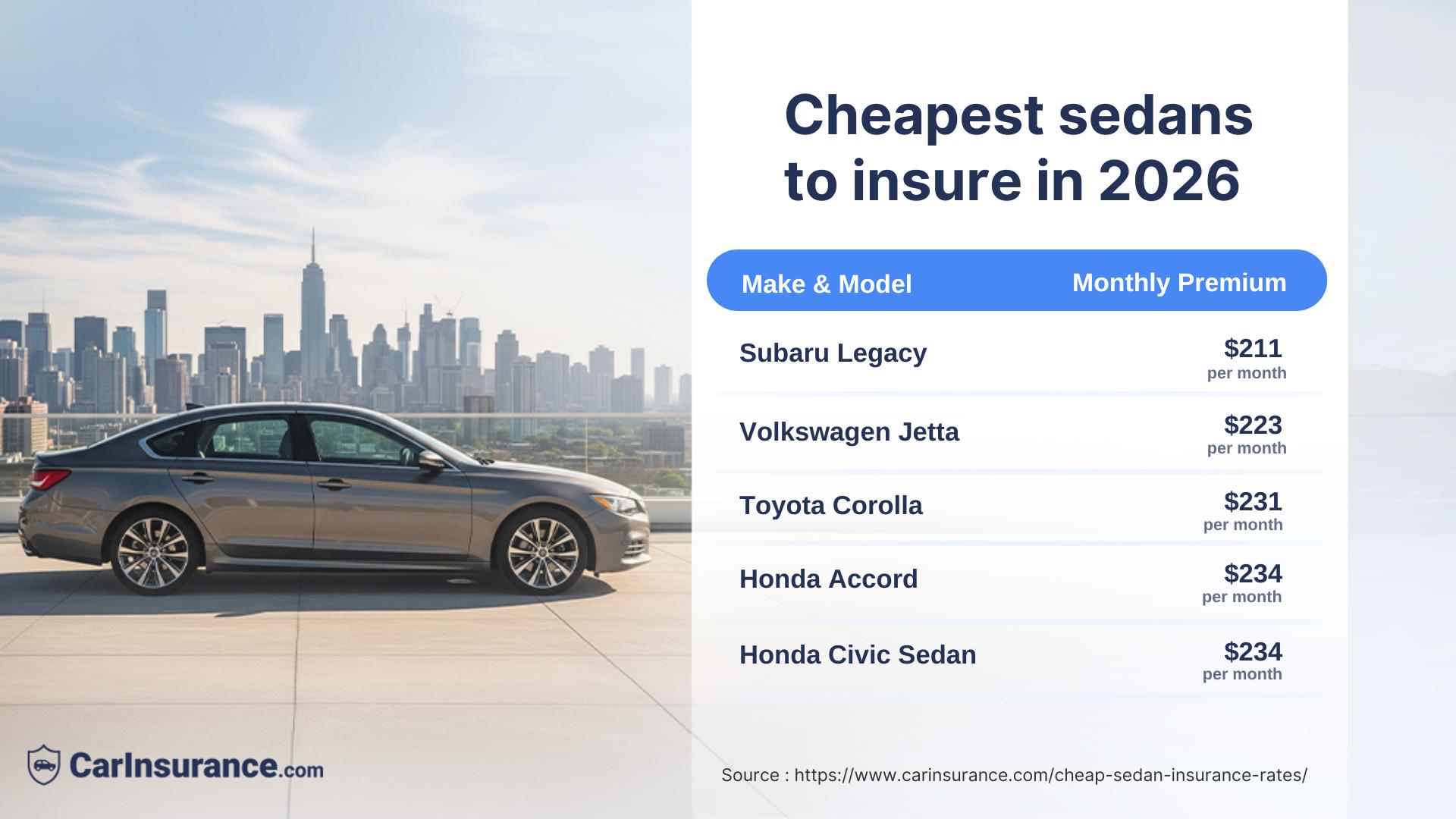
- The cheapest sedans to insure are the Subaru Legacy, Volkswagen Jetta, Toyota Corolla, Honda Accord and Honda Civic.
The difference in insurance rates between two different sedans can be as much as 60% — and that’s important data when you’re shopping for a new car. According to a CarInsurance.com analysis of Quadrant Information Services rate data, the Subaru Legacy is the cheapest sedan to insure in 2026.
Keep reading for our full analysis and ranking of sedans by average insurance rate.

What are the cheapest sedans to insure?
The Subaru Legacy is the cheapest sedan to insure at an average annual premium of $2,529, according to CarInsurance’s data.
No. 1: Subaru Legacy
- Cost: $2,529 per year; $211 per month
No. 2: Volkswagen Jetta
- Cost: $2,677 per year; $223 per month
No. 3: Toyota Corolla
- Cost: $2,771 per year; $231 per month
No. 4: Honda Accord
- Cost: $2,804 per year; $234 per month
No. 5: Honda Civic
- Cost: $2,809 per year; $234 per month
Which companies provide the cheapest car insurance for sedans?
Travelers offers the cheapest car insurance rates for sedans, starting at an annual average premium of $1,763 for a Subaru Legacy. Learn how other insurance companies’ annual premiums rank in the table below.
| Make model | Company | Annual rates | Six-month rates | Monthly rates |
|---|---|---|---|---|
| Subaru Legacy | Travelers | $1,763 | $882 | $147 |
| Volkswagen Jetta | Travelers | $1,988 | $994 | $166 |
| Mazda 3 | Travelers | $1,993 | $997 | $166 |
| Honda Accord | Travelers | $2,013 | $1,007 | $168 |
| Nissan Versa | GEICO | $2,045 | $1,023 | $170 |
| Volkswagen Jetta GLI | Travelers | $2,050 | $1,025 | $171 |
| Toyota Corolla | GEICO | $2,073 | $1,037 | $173 |
| Honda Civic | Travelers | $2,184 | $1,092 | $182 |
| Hyundai Sonata | Travelers | $2,299 | $1,149 | $192 |
| Chevrolet Malibu | GEICO | $2,313 | $1,156 | $193 |
| Kia K4 | Travelers | $2,316 | $1,158 | $193 |
| Hyundai Elantra | Travelers | $2,317 | $1,159 | $193 |
| Nissan Sentra | GEICO | $2,341 | $1,171 | $195 |
| Nissan Altima | Travelers | $2,411 | $1,205 | $201 |
| Kia K5 | Travelers | $2,437 | $1,219 | $203 |
Do insurance companies consider the vehicle size when setting rates?
Yes. When determining premiums, car insurance companies typically consider the type of car you drive, its cost, potential repair costs and theft. Additionally, they assess safety features, potential damage to another car during an accident and luxury model features.
According to our data, drivers of a small Toyota Corolla can estimate an average annual premium of $2,771. Compared with drivers of a midsize Honda Accord, drivers of a midsize Honda Accord have an average annual premium of $2,804, a difference of $33. Drivers of a full-size Nissan Altima can see an increase of about $300, with an average annual premium of $3,114 for full coverage car insurance (liability plus collision and comprehensive coverage).
Cheapest small sedans to insure
According to our analysis, the Volkswagen Jetta is the cheapest small sedan to insure through Travelers. The table below shows what other insurance companies offer the cheapest coverage for sedans.
| Make model | Company | Annual rates | Six-month rates | Monthly rates |
|---|---|---|---|---|
| Volkswagen Jetta | Travelers | $1,988 | $994 | $166 |
| Mazda 3 | Travelers | $1,993 | $997 | $166 |
| Volkswagen Jetta GLI | Travelers | $2,050 | $1,025 | $171 |
| Toyota Corolla | GEICO | $2,073 | $1,037 | $173 |
| Honda Civic | Travelers | $2,184 | $1,092 | $182 |
| Kia K4 | Travelers | $2,316 | $1,158 | $193 |
| Hyundai Elantra | Travelers | $2,317 | $1,159 | $193 |
| Nissan Sentra | GEICO | $2,341 | $1,171 | $195 |
Cheapest midsize sedans to insure
The Subaru Legacy is the cheapest midsize sedan to insure through Travelers, according to our data. Learn more about the cheapest midsize sedans to insure in the table below.
| Make model | Company | Annual rates | Six-month rates | Monthly rates |
|---|---|---|---|---|
| Subaru Legacy | Travelers | $1,763 | $882 | $147 |
| Honda Accord | Travelers | $2,013 | $1,007 | $168 |
| Hyundai Sonata | Travelers | $2,299 | $1,149 | $192 |
| Chevrolet Malibu | GEICO | $2,313 | $1,156 | $193 |
| Nissan Altima | Travelers | $2,411 | $1,205 | $201 |
| Kia K5 | Travelers | $2,437 | $1,219 | $203 |
Cheapest full-size sedans to insure
The Toyota Camry is the cheapest full-size sedan to insure through Travelers. Full-size sedans typically don’t rank in the “cheap” category, but you can explore the average rates for them below.
| Make model | Company | Annual rates | Six-month rates | Monthly rates |
|---|---|---|---|---|
| Toyota Camry | Travelers | $2,070 | $1,035 | $172 |
| Hyundai Sonata | Travelers | $2,299 | $1,149 | $192 |
| Chevrolet Malibu | GEICO | $2,313 | $1,156 | $193 |
| Nissan Altima | Travelers | $2,411 | $1,205 | $201 |
 Are new or used cars cheaper to insure?
Typically, it’s more expensive to insure a new car than an older one. That’s because a newer vehicle is more valuable, making it more expensive to repair or replace than an older sedan.
Speak with a friendly agent and get your quote in minutes!


What are the car insurance requirements for sedans?
The insurance requirements for sedans are the same as for other types of vehicles. Below are the car insurance options, but keep in mind that these are not all legal requirements, which vary by state:
- Liability: If you injure another person or damage their property while at the wheel of your sedan, bodily injury liability and property damage liability will help cover damages up to your policy’s limits. Liability coverage is required in most U.S. states.
- Collision: If your car is damaged or destroyed after a collision with another car, collision coverage will cover damage.
- Comprehensive: Should your vehicle be damaged or destroyed by something other than a collision – fire, flooding, vandalism, theft, weather events or an animal strike – comprehensive coverage comes to the rescue.
- Uninsured motorist/underinsured motorist: If your car is damaged in a crash with an uninsured or underinsured driver, UM/UIM coverage will help foot the repair bill.
Sophie’s tip
If you own your sedan outright, liability-only is the cheapest legal option in most states. If you’re leasing or financing, your lender will require full coverage, so comprehensive and collision aren’t optional.
How much you’ll pay for car insurance depends on several factors:
- Insurance company
- Age, make and model of the vehicle
- Address where the vehicle is garaged
- Coverage amounts (the more extensive the coverage, the more expensive)
- Deductible (a higher deductible means a cheaper premium)
- Individual driving history
- State of residency
The cheapest type of insurance for sedans that is currently available is liability-only insurance. But if you’re leasing or financing your car, you need comprehensive and collision insurance and liability insurance.
How has the cost of insurance changed over time?After skyrocketing in 2025, car insurance costs slowed their rise in 2026 and even began to drop. The U.S. Bureau of Labor Statistics reported that insurance rates fell 4.1% year-over-year in June 2026.
How much is insurance for a sedan for an 18-year-old vs. a 40-year-old?
The cheapest sedan insurance for a teen driver is $8,130 per year for a Subaru Legacy. In general, teen drivers pay significantly more for insurance than 40-year-old drivers. As drivers gain experience behind the wheel, they pose less risk for insurers, leading to lower rates. For example, a 40-year-old driver pays an average annual rate of $2,529 to insure a Subaru Legacy — almost 70% less.
For families adding teen drivers to their insurance policy, the choice of vehicle can make a difference. Insuring a Subaru Legacy ($678 per month) costs about 36% less than insuring a Kia K4 ($1,071 per month).
Explore how rates vary across other vehicles by driver age below.
| Make model | Annual rates | Six-month rates | Monthly rates |
|---|---|---|---|
| Subaru Legacy | $8,130 | $4,065 | $678 |
| Volkswagen Jetta | $8,820 | $4,410 | $735 |
| Honda Accord | $9,066 | $4,533 | $756 |
| Toyota Corolla | $9,106 | $4,553 | $759 |
| Honda Civic | $9,202 | $4,601 | $767 |
| Mazda 3 | $9,218 | $4,609 | $768 |
| Nissan Versa | $9,474 | $4,737 | $790 |
| Volkswagen Jetta GLI | $9,480 | $4,740 | $790 |
| Chevrolet Malibu | $9,529 | $4,764 | $794 |
| Hyundai Elantra | $9,905 | $4,953 | $825 |
| Nissan Sentra | $9,936 | $4,968 | $828 |
| Hyundai Sonata | $10,129 | $5,065 | $844 |
| Nissan Altima | $10,151 | $5,075 | $846 |
| Kia K5 | $10,385 | $5,192 | $865 |
| Kia K4 | $12,847 | $6,424 | $1,071 |
| Make model | Annual rates | Six-month rates | Monthly rates |
|---|---|---|---|
| Subaru Legacy | $2,529 | $1,265 | $211 |
| Volkswagen Jetta | $2,677 | $1,339 | $223 |
| Toyota Corolla | $2,771 | $1,386 | $231 |
| Honda Accord | $2,804 | $1,402 | $234 |
| Honda Civic | $2,809 | $1,404 | $234 |
| Mazda 3 | $2,817 | $1,408 | $235 |
| Volkswagen Jetta GLI | $2,885 | $1,443 | $240 |
| Nissan Versa | $2,894 | $1,447 | $241 |
| Chevrolet Malibu | $2,897 | $1,448 | $241 |
| Nissan Sentra | $3,013 | $1,506 | $251 |
| Hyundai Elantra | $3,030 | $1,515 | $253 |
| Hyundai Sonata | $3,097 | $1,549 | $258 |
| Nissan Altima | $3,114 | $1,557 | $260 |
| Kia K5 | $3,192 | $1,596 | $266 |
| Kia K4 | $4,017 | $2,008 | $335 |
What leads to higher car insurance costs for sedans?
The top five factors that push a sedan’s insurance cost higher are the vehicle’s make and model, rate of theft, repair cost, market value and safety features.
Here’s how those factors can lead to a higher insurance cost for sedans:
- Car make and model: The price tag of your insurance hinges on the specific car make and model. Luxury vehicles, larger cars, more powerful engines and models with more bells and whistles mean more expensive car insurance.
- Potential for theft: One downside to sedans’ popularity is that they are also attractive to car thieves, Hardesty says. Of the top-stolen cars in the U.S., seven out of 10 are sedans, according to the National Insurance Crime Bureau.
- Cost to repair: Sedans with more features, electronic components or expensive parts will cost more, which will raise the insurance premium.
- Market value: Sedans with a higher market value — or resale value — will have a higher insurance price tag.
- Safety features: Sedans with safety features such as brake assist, airbags, anti-lock brakes and backup cameras can lower the odds of getting into a car crash, decreasing your insurance cost.
The number of variables factored into your car insurance rate can make your head spin, says Chris Hardesty, an insurance expert and senior advice editor for Kelley Blue Book.
“Driver-assist technologies can make your car safer on the road and potentially avoid a crash,” Hardesty says. “At the same time, those electronic features are more expensive to repair or replace following an accident. It’s good that insurance companies have tremendous amounts of data to help them predict risk and cost.”
Quotable insightYour choice of vehicle can swing the premium by as much as 59%. That’s the difference between the average cost of insuring a Subaru Legacy ($2,529) and a Kia K4 ($4,017).
How to save money on car insurance for sedans
To save on car insurance, understand that an older car will also be cheaper to insure than a newer luxury model. And the higher your deductible, the lower your premium and vice versa.
Take these steps before buying a car insurance policy for your sedan:
- Research to see what type of coverage you need: As mentioned before, you’ll want to see what types of insurance and coverage amounts you’ll need. Each state has different requirements, and most states require liability. If you are leasing or financing a car, you’ll most likely need full coverage, which includes comprehensive and collision insurance.
- Comparison shop: To save on car insurance for your sedan, it’s important to do your research to get an idea of the rates. Get a few quotes from several insurers for the same types and coverage amounts. The beauty of car insurance is that you can hop on a new policy with a different insurance company at any time.
- Look for discounts: You’ll also want to see if there are any discounts. Common discounts for car insurance include a good driver discount, a membership discount if you’re affiliated with a certain organization, a multi-vehicle discount and bundled discount if you purchase both a homeowners insurance and auto insurance policy with the same company.
Are sedans cheaper to insure than SUVs or sports cars?
No, sedans are more expensive to insure than SUVs. According to our data, an SUV’s average annual insurance premium is $2,976, while a sedan costs $3,781 per year for full coverage.
Why’s that? Well, it has to do with safety considerations.
“Those SUVs and trucks have grown heavier and taller, while sedans are comparatively petite and close to the road,” Hardesty says. “The difference in weight and stature can put sedans at a disadvantage, leading to higher insurance rates.”
However, sedans are significantly cheaper to insure than sports cars. The average annual premium to insure a sports car is $3,880. Again, this boils down to safety features and underlying value.
Sedan car insurance in a nutshell
When shopping around for insurance for a sedan, consider what you use your car for, how often you drive, and your personal budget. If you want cheaper car insurance rates, opt for a used car with fewer features.
If a luxury model or a sedan with more advanced features is a better fit for your needs and lifestyle, then there’s no reason to deprive yourself — know it will cost more to insure.
Sophie’s tip
A sedan that costs more to insure isn’t a dealbreaker. If the car fits your life, you can offset the premium by raising your deductible, bundling home and auto, and comparing a few carriers before you buy.
Frequently Asked Questions: Sedan car insurance
Do luxury sedans have higher insurance costs than standard sedans?
Yes, luxury cars come with an average annual premium of $3,952. In contrast, standard sedans have an average annual premium of $3,781.
Do four-door sedans have lower insurance rates than two-door cars?
On average, you’ll pay 16% more to insure a coupe (two-door car) than a sedan (four-door car).
Do older sedans have lower insurance rates than new sedans?
Yes, older sedans are typically cheaper to insure than new sedans.
What is the cheapest sedan to insure?
The Subaru Legacy is the cheapest sedan to insure, with an average annual rate of $2,529 for full coverage. It’s followed by the Volkswagen Jetta and the Toyota Corolla. Rates vary depending on your driving record, driver profile, state and insurance company, so compare a few quotes.
Is a Toyota Corolla or Honda Civic cheaper to insure?
Although it’s close, a Toyota Corolla is $38 cheaper to insure, with an average rate of about $2,771 a year compared to $2,809 for a Honda Civic. Your own rate depends more on your driver profile, insurance company and coverage selections than it does on which badge is on your grille.
What’s the most expensive sedan to insure on this list?
Among the models we priced, the Kia K4 is the costliest to insure at about $4,017 a year for full coverage. That’s about 59% higher than the Subaru Legacy’s average rate of $2,529.
Resources & Methodology
Sources
- Bureau of Labor Statistics, “Consumer Price Index for All Urban Consumers (CPI-U): U. S. city average, by detailed expenditure category.” Accessed August 2026 .
- Kelley Blue Book. “In an SUV World, Can Cars Make a Comeback?” Accessed August 2026 .
- National Insurance Crime Bureau. “U.S. Vehicle Thefts Experience Historic Decline.” Accessed August 2026 .
Methodology
CarInsurance.com editors collected rates from Quadrant Information Services for 40-year-old male and female drivers carrying a full coverage insurance policy with limits 100/300/100 and $500 comprehensive and collision deductibles. Read the detailed methodology for more information.

 Still have a question? Ask our experts
Get advice from an experienced insurance professional. Our experts will help you navigate your insurance questions with clarity and confidence.
Browse all FAQs